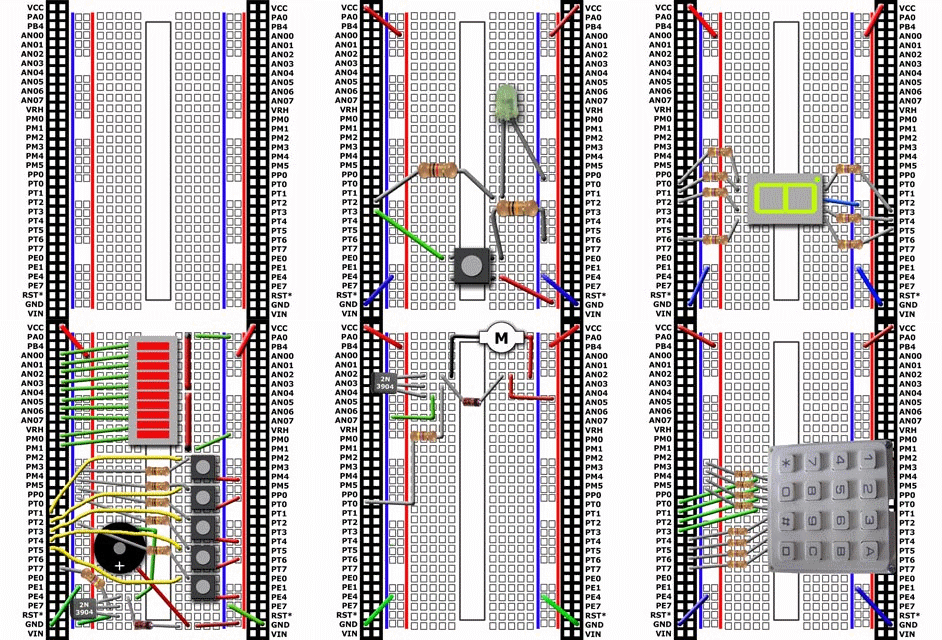
Overview
NanoCore12 is a microcontroller platform based on flexible, easy-to-use hardware and software. It was created for hobbyists, students, engineers, artists, designers-- anyone interested in creating interactive objects or environments.
NanoCore12 can sense its environment through various sensors and can affect its environment by controlling various devices: lights, motors, sound transducers, and various actuators. The microcontroller on NanoCore12 can be programmed with Assembler, BASIC, C, or Forth. NanoCore12 projects can be autonomous or they can communicate with software running on a computer (e.g. Adobe Flash, VisualBASIC, C#, etc.).
NanoCore12 currently comes in three versions:
- a 24-pin drop-in Stamp-replacement (NC12C32S)
- a 32-pin Stamp-superset (NC12DXC32S)
- a 40-pin module with on-board CAN transceiver (NC12MAXC32S or NC12MAX128S)
Besides on-board RS232 transceiver, voltage regulator, crystal and PLL support circuitry, all NanoCore12 modules sport a MC9S12C MCU, loaded with up to 128K Flash, up to 4K RAM, and a rich assortment of advanced on-chip hardware peripherals. Not only is it blazingly fast (24MHz bus) and powerful, but it is a breeze to multi-task for such demanding apps as robotics and real-time control.

Software Development:
A free Special Edition of the industry standard CodeWarrior Studio for Windows is available from Freescale, and supports up to 32K of C source code, and unlimited assembler. See Resources for details.
For educational and hobbyist (i.e. non-commercial) applications, the free SBASIC compiler by Karl Lunt is a good choice. While it is a DOS cross-compiler, it is easily used from Windows. Also from Karl Lunt is the free Tiny4th compiler. See Resources for details and URLs.
Hardware Features:
| Product Name >> |
NC12C32 |
NC12DXC32 |
NC12MAXC32 |
NC12MAXC128 |
| Microcontroller | MC9S12C32 | MC9S12C32 | MC9S12C32 | MC9S12C128 |
| Operating Voltage | 5V or 3.3V |
5V or 3.3V | 5V or 3.3V | 5V or 3.3V |
| Input Voltage (nom.) | 7-12V | 7-12V | 7-12V | 7-12V |
| Input Voltage (limits) | 5-18V | 5-18V | 5-18V | 5-18V |
| Digital I/O Pins: |
18 total: |
24 total: |
29 total: |
29 total: |
| Analog Pins (10-bit) |
8 |
8 |
8 |
8 |
| DC Current per I/O Pin | 25 mA | 25 mA |
25 mA | 25 mA |
| Available DC Current from Vcc Pin | 60 mA | 60 mA |
60 mA | 60 mA |
| Flash Memory | 32K of which 2K is used by bootloader | 32K of which 2K is used by bootloader | 32K of which 2K is used by bootloader | 128K of which 2K is used by bootloader |
| SRAM | 2K | 2K |
2K |
4K |
| Oscillator Frequency |
8 MHz | 8 MHz | 8 MHz | 8 MHz |
| Bus Speed |
24 MHz |
24 MHz | 24 MHz | 24 MHz |
®BASIC Stamp is a registered trademark of Parallax, Inc.
| Product | NC12C32 |
NC12DXC32 |
NC12MAXC32 |
NC12MAXC128 |
Microcontroller | MC9S12C32 | MC9S12C32 | MC9S12C32 | MC9S12C128 | Operating Voltage | 5V or 3.3V |
5V or 3.3V | 5V or 3.3V | 5V or 3.3V | Input Voltage (nom.) | 7-12V | 7-12V | 7-12V | 7-12V | Input Voltage (limits) | 5-18V | 5-18V | 5-18V | 5-18V | Digital I/O Pins: |
18 total: |
24 total: |
29 total: |
29 total: |
Analog Pins | 8 |
8 |
8 |
8 |
DC Current per I/O Pin | 25 mA | 25 mA |
25 mA | 25 mA | Available DC Current from Vcc Pin | 60 mA | 60 mA |
60 mA | 60 mA | Flash Memory | 32K of which 2K is used by bootloader | 32K of which 2K is used by bootloader | 32K of which 2K is used by bootloader | 128K of which 2K is used by bootloader | SRAM | 2K | 2K |
2K |
4K |
Oscillator Frequency | 8 MHz | 8 MHz | 8 MHz | 8 MHz | Bus Speed | 24 MHz |
24 MHz | 24 MHz | 24 MHz |